AI

ARCHITECTURE

DIGITAL PRESENCE

AI Workflow for Renders: The Future of Visualization

From sketch to cinematic visualization, how AI can elevate your rendering workflow. AI is redefining the practice of architectural visualization not by replacing the designer’s eye, but by transforming the relationship between imagination and image. Rendering has long been one of the most laborious passages in the design process, where time, precision, and technology converge to give shape to vision. Today, through the integration of AI-driven tools, this process becomes more fluid, more intuitive: a continuum between concept and visual presence. The value of these technologies lies not solely in their efficiency, but in their capacity to open new interpretive dimensions. They invite us to explore light, material, and atmosphere with a freedom that was once constrained by technical demands. Before the model is complete, before geometry is fixed, the architect can already *see*, anticipate, and communicate. Below are five ways in which AI can become a silent collaborator in the rendering process, accelerating production while deepening the expressive potential of design.
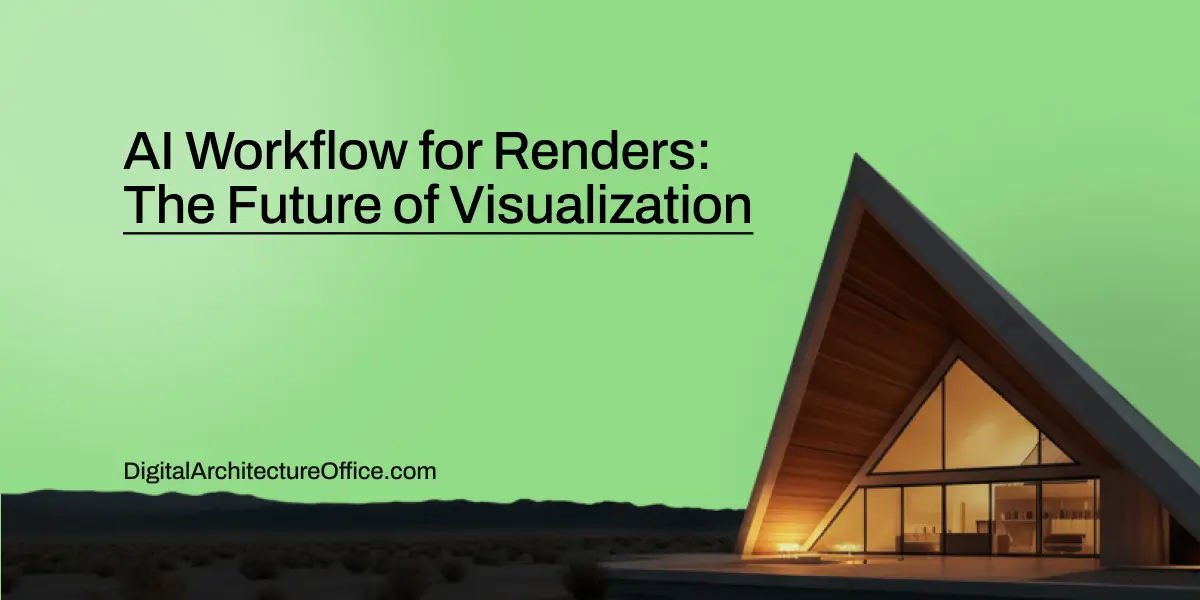
Immagine con sfondo verde che mostra una casa moderna triangolare illuminata di notte nel deserto, accompagnata dal testo: 'AI Workflow for Renders: The Future of Visualization'. In basso è visibile il sito web DigitalArchitectureOffice.com.

1. From Sketch or Image to Render


Every project begins in uncertainty: a sketch traced on paper, a fragment of geometry, an intuition. Traditionally, translating that early vision into a rendered image required a long chain of modeling, texturing, and lighting. AI now acts as a bridge between the abstract and the visible.


Using text-to-image and image-to-image generation tools, even the most minimal input can become a rendered vision within minutes. These systems read spatial intent and material tone as an architect might—through atmosphere rather than data.


AI can transform:

  • A hand-drawn sketch into a visual study of massing and light.

  • A model screenshot into a realistic rendering of form and context.

  • A reference image into an atmospheric translation of intent.


Such immediacy is invaluable for early presentations, mood explorations, and client conversations. It transforms the sketch into a spatial statement, something halfway between drawing and dream.


2. AI Upscaling and Scene Optimization


Rendering has always been a negotiation between quality and time. High-resolution, noise-free images once required patience, hardware, and technical discipline. AI reshapes this equation.


Through AI denoisers and upscalers, low-sample renders can now be elevated to full visual clarity without prolonged computation. The outcome is not only efficiency, but a shift in rhythm: an iterative process where ideas evolve as quickly as they appear.


AI can also assist in scene optimization, allowing for:

  • Automatic simplification of heavy geometry.

  • Intelligent culling of unseen or redundant elements.

  • Dynamic material and lighting adjustments for faster previews.


The designer remains central, yet freed from the inertia of process, able to focus once again on composition, proportion, and atmosphere.


3. Lighting and Seasonal Variation


Light defines architecture through its change. Once a scene exists, AI can reinterpret it under multiple conditions, revealing how space responds to time.


With simple prompts, a single render can evolve into a sequence of variations:

  • Morning, dusk, or night versions.

  • Sunny or overcast atmospheres.

  • Summer and winter interpretations of the same façade.


These transformations allow architecture to be read as a living organism: materials shifting tone, shadows elongating, textures absorbing light differently. It is a study in perception, a visual narrative of how buildings breathe with the day.


4. Facade Openings and Design Testing


Variation lies at the heart of design research: the dialogue between one possibility and another. Testing façade openings or surface patterns, however, can be laborious. AI returns immediacy to this exploration.


By sketching directly onto a render or prompting an AI image editor, designers can:

  • Modify window proportions or shading systems.

  • Test panel articulations or perforation patterns.

  • Visualize light distribution and glazing ratios before simulation.


Within minutes, one can produce a coherent series of façade studies, each consistent in context, yet distinct in expression. This process enhances early design dialogue, allowing intuition to precede precision.


5. From Still Image to Video Timelapse


Once the still image is born, motion becomes inevitable. AI now makes that transition effortless, extending the single frame into time.


From one image, designers can create:

  • Camera movements and cinematic fly-throughs.

  • Lighting transitions, from sunrise to nightfall.

  • Seasonal or atmospheric shifts, revealing temporal change


These animations are not mere effects but spatial narratives—visual essays that express mood and evolution. They turn architectural visualization into a form of storytelling, where movement communicates emotion as much as form.


Bringing It All Together


AI does not dismantle the rendering process; it redefines its rhythm. It shifts the focus from the mechanics of production to the poetics of visualization.


A contemporary workflow might unfold as a sequence of gestures: sketching ideas, generating early atmospheres, refining scenes through optimization, experimenting with light and material, and finally giving motion to the image.


What emerges is a new form of authorship, one where technology extends rather than interrupts creative thought. AI becomes an ally that accelerates without impoverishing, clarifies without simplifying. It allows the architect to see earlier, test wider, and narrate space with greater emotional and material precision.


In this sense, AI for rendering is not automation; it is amplification. It is the continuation of the designer’s gaze into new temporal and visual dimensions.


Contact us using the form below to get a free consultation and receive a strategic roadmap for integrating AI into your workflow.

Share If You Like!

background

Ready to Take Your Real Estate Business to New Heights?

Book your free consultation now to discover how to transform your website into a client acquisition powerhouse.

Other articles that may interest you

PROPERTY ACQUISITION

PROPERTY LISTING

REAL ESTATE

How to Attract More Property Sellers Through Your Website (One Strategic Upgrade at a Time)

Real estate has entered a stage of digital maturity where sellers, not just buyers, navigate the market with increasingly refined expectations. Before contacting an agent, property owners evaluate competence, expertise, and marketing capability: all through your website. Your website isn’t just a digital brochure: it’s where a potential seller decides whether to trust you or keep searching. Yet many real estate sites still lack strong seller-focused messaging, structured pathways, and compelling proof of value. Now more than ever, a website optimized to attract sellers is a powerful competitive advantage. Below are five strategic enhancements that will turn your website into a magnet for property owners ready to sell.

December 3, 2025

REAL ESTATE

LEAD GENERATION

WEB DESIGN

Why 2026 Is the Year to Redesign Your Real Estate Website (One Digital Upgrade at a Time)

Real estate is evolving into a more digitally mature environment. Buyers and sellers now navigate the market with architectural clarity: they expect seamless interfaces, refined information design, and immersive media that brings properties to life. In this context, your website is more than an online presence: it is the structural core of your brand. Yet many real estate websites still reflect outdated templates, slow infrastructure, and fragmented experiences built for a previous browsing era. 2026 offers an ideal moment to rebuild, not as a cosmetic refresh, but as a strategic redesign aligned with modern expectations. Below are five digital upgrades shaping today’s most effective real estate websites, each one designed to elevate your credibility and accelerate growth.

November 26, 2025

AI

CHATGPT

REAL ESTATE

How AI-Powered Media Is Rewriting Real Estate Marketing (One Digital Trend at a Time)

Artificial Intelligence isn’t just changing how we snap photos… It’s reshaping how real estate agents think, market, and sell. While virtual staging and 3D models make listings look polished, AI works behind the quinte, transforming the hidden parts of the process: content creation, personalization, storytelling, and analytics. From the first lead to the closing, AI helps agencies automate the repetitive, amplify creativity, and deliver data-driven experiences, all through simple, natural-language prompts. Here are five powerful “digital trend prompts” that can quietly transform your real estate business…one command at a time.

November 19, 2025

AI

ARCHITECTURE

CHATGPT

How ChatGPT Is Quietly Transforming Architecture Studios (One Prompt at a Time)

Artificial Intelligence isn’t just changing how we render…It’s reshaping how architects think, plan, and deliver. While visualization tools like Midjourney, Enscape, or Stable Diffusion make your designs look stunning, ChatGPT works behind the scenes, transforming the hidden parts of the process: organization, creativity, documentation, and communication. From the first client meeting to the final presentation, ChatGPT helps architects automate the repetitive, amplify creativity, and structure the complex, using nothing more than natural language. Here are five powerful prompts that can quietly transform the way your studio works — one command at a time.

November 12, 2025

PROPERTY ACQUISITION

PROPERTY LISTING

REAL ESTATE

How to Attract More Property Sellers Through Your Website (One Strategic Upgrade at a Time)

Real estate has entered a stage of digital maturity where sellers, not just buyers, navigate the market with increasingly refined expectations. Before contacting an agent, property owners evaluate competence, expertise, and marketing capability: all through your website. Your website isn’t just a digital brochure: it’s where a potential seller decides whether to trust you or keep searching. Yet many real estate sites still lack strong seller-focused messaging, structured pathways, and compelling proof of value. Now more than ever, a website optimized to attract sellers is a powerful competitive advantage. Below are five strategic enhancements that will turn your website into a magnet for property owners ready to sell.

December 3, 2025

REAL ESTATE

LEAD GENERATION

WEB DESIGN

Why 2026 Is the Year to Redesign Your Real Estate Website (One Digital Upgrade at a Time)

Real estate is evolving into a more digitally mature environment. Buyers and sellers now navigate the market with architectural clarity: they expect seamless interfaces, refined information design, and immersive media that brings properties to life. In this context, your website is more than an online presence: it is the structural core of your brand. Yet many real estate websites still reflect outdated templates, slow infrastructure, and fragmented experiences built for a previous browsing era. 2026 offers an ideal moment to rebuild, not as a cosmetic refresh, but as a strategic redesign aligned with modern expectations. Below are five digital upgrades shaping today’s most effective real estate websites, each one designed to elevate your credibility and accelerate growth.

November 26, 2025

digital architecture office logo
Terms of Service

© 2025 Digital ArchiteCture Office. All rights reserved.

digitalarchitectureoffice@gmail.com