REAL ESTATE
MARKETING
RENDER
AI and Architectural Rendering: How Visualization is Changing in 2026
There's a scene every architect knows all too well. The client looks at the architectural rendering. Pauses.
Then says:
"Beautiful… but can I see the kitchen in a different color?"
Silence.
Your blood runs cold.
You think about the hours lost, the render settings, the materials, the overnight rendering that might be ready tomorrow morning.
For years, architectural visualization has been exactly this:
a creative bottleneck 🧊
From drafting tables to rendering farms (and back)
First AutoCAD.
Then Rhino.
Then, for the bold ones, 3ds Max.
V-Ray as a rite of passage.
Cinema 4D as a promise of creative freedom.
Twinmotion tried to save us.
It did… halfway.
Because the problem wasn't just speed.
It was the workflow.
Too many steps.
Too much distance between idea and image.
Too much energy spent producing instead of designing.
Then AI arrived.
And it flipped the table.
The real breakthrough isn't the tool. It's the paradigm shift.
Today we're drowning in software promising miracles.
One-click renders.
Automatic videos.
Intelligent materials.
But the right question isn't:
"Which tool should I use?"
The right question is:
"How do I design when rendering is no longer a bottleneck?" ⚡
Core use cases for AI in architectural visualization (today, not tomorrow)
Let's get concrete. The cases that truly matter.
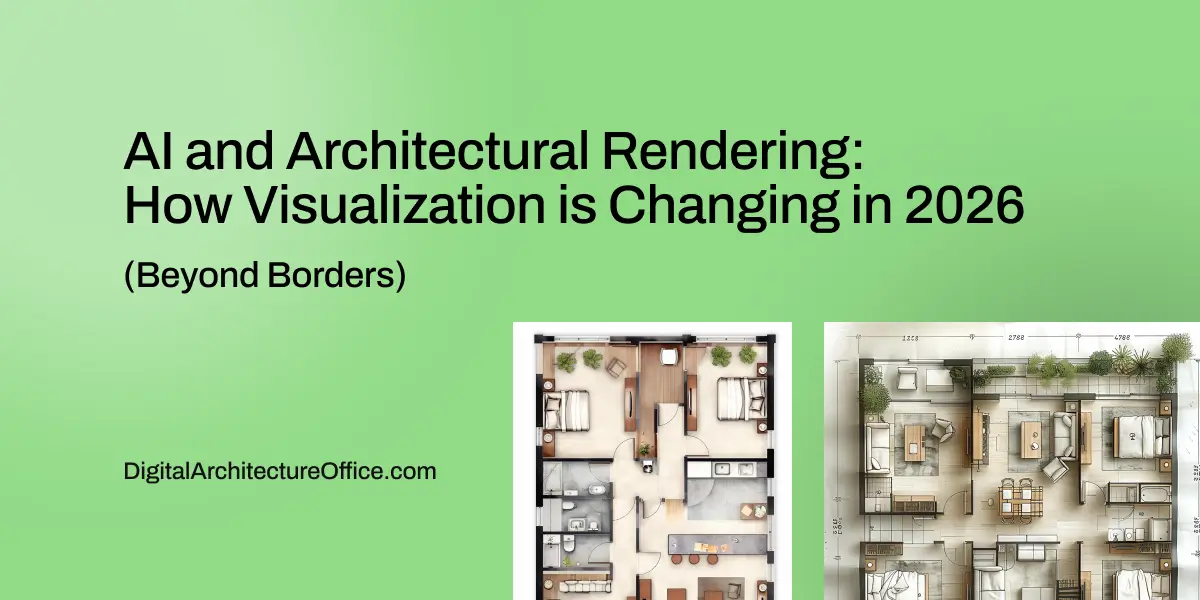
1. Presenting polished floor plans to clients
A sketch, a rough plan, an idea.
AI transforms it into a readable, elegant, presentation-ready document.
You're not cheating.
You're accelerating.
2. Varying furniture, colors, and moods in the same space
Before: duplicate scenes, materials, lighting setups.
Now: prompts, variations, alternatives.
The client chooses. You guide.
3. Getting a render from 3D without hours of computation
Simple model.
No obsession over technical details.
AI interprets, completes, enhances.
Time is on your side again.
4. No time for a video walkthrough
Minimal storyboard.
Few inputs.
Dynamic, emotional output, ready to convince. 🎥
The real revolution: using renders during design, not after
This is the game-changer.
Today you can use architectural renders during the design phase, not just for final presentations.
Sketch → image.
Quick 3D → atmosphere.
Idea → perceived space.
In under a minute.
The creative phase isn't replaced.
It's amplified.
But beware ⚠️
More speed also means higher expectations.
Clients get used to quality.
Quality becomes the baseline.
You need to be ready.
New possibilities = new markets
AI isn't just a tool.
It's a service enabler.
Preliminary projects for real estate agents
(selling a vision before the actual project)
Scenography and event settings
(temporary spaces that need immediate impact)
Visual concepts for tenders, pitches, competitions
(decide faster, convince better)
And then there's the unspoken part.
Rendering as a management and communication tool
Rendering is no longer just the final image.
It becomes:
a client alignment tool
real-time design verification
shared language across teams
And most importantly…
it becomes content.
The next step isn't publishing floor plans anymore.
It's showing how plans become space.
On social media.
In marketing.
In your firm's storytelling.
Have you thought about it?
The point isn't using AI. It's designing with AI.
Who wins in 2026 isn't who knows more tools.
It's who has a clear, repeatable, scalable workflow.
This is where consulting comes in.
Not to teach you "which button to press",
but how to rethink the way you work.
If you want to transform AI from a toy into a professional leverage,
let's talk.
The future of architectural visualization isn't coming.
It's already here. 🚀